Over half of distance-weighted U.S. freight is shipped using more than one transport mode. We examine how multimodal transport networks shape the economic and environmental impacts of infrastructure investments and disruptions. We develop a tractable spatial equilibrium model of multimodal routing with mode-specific congestion at intermodal terminals. We estimate a modal substitution elasticity using road and rail data, and a terminal congestion elasticity using vessel-positioning data. Calibrated to the U.S. freight network, the model identifies key bottlenecks and quantifies $0.46-$1.85 billion in real GDP gains from intermodal terminal improvements, with additional environmental benefits from shifting away from carbon-intensive road transport. Ignoring mode-specific congestion overstates welfare gains from highway improvements by 85%, while ignoring multimodal flexibility understates them by 22%. Losing rail network access is estimated to reduce real GDP by $230 billion.
How do large export-demand shocks propagate across connected labor markets? This paper studies the regional incidence of the WWI trade boom in Spain using newly assembled data on product-destination exports, province-sector wages and employment, and province-product consumer prices (1910-1920). Exploiting plausibly exogenous shifts in foreign demand from belligerent nations, I use a reduced-form design that decomposes exposure into direct (local) effects and spillovers across connected markets. Exposed markets experienced large increases in nominal wages and employment; within-province wage spillovers are roughly half the size of the direct effect. These nominal gains were partially offset by rising local consumer prices. To interpret these patterns, I develop a quantitative spatial equilibrium model with nested labor mobility across regions and sectors. The model implies that limited interprovincial mobility dampened worker reallocation and amplified wage and price pressures, shaping the spatial distribution of real-income gains. Counterfactuals show that spatial labor-market segmentation is an important amplifier of incidence: removing spatial migration frictions reduces cross-province dispersion in nominal wages and real income, while shifting adjustment toward reallocation rather than local wage/price pressure. Moreover, making the export-demand impulse spatially even sharply compresses inflation dispersion, implying that both the geography of the shock and domestic segmentation are first-order for the distribution of gains.
We study the trade-off firms face when exporting to countries with different tastes and volatile demand. In our model, firms face a portfolio problem where they trade off supplying the largest consumer groups against higher exposure to group-specific risk. We develop an empirical strategy to estimate consumer taste from observed market shares, as well as the key parameters that pin down the firm’s portfolio choice problem. We apply our framework to estimate the impact of the rise of China on the global movie market and characterize the heterogeneous welfare effects across countries. A calibrated version of our model suggests a modest average consumer welfare loss as firms prioritize products that provide insurance value.
How do we evaluate the welfare gains from transport infrastructure investment? We present a quantitative spatial framework that integrates traffic and economic responses to infrastructure improvements and derives the elasticity of aggregate welfare to changes in the transportation network. The resulting formula extends the traditional “social savings” method to incorporate route and mode choice, agglomeration and dispersion externalities, and traffic congestion. We apply the formula to the U.S. freight network and assess the benefits of reducing costs on each segment of the U.S. Interstate Highway System. The traditional and extended measures are closely related overall, but they differ in the level of estimated gains and in the ranking of some highly valued links. Where the rankings differ, network position determines how congestion and spatial adjustment alter a link's measured benefit.
We study how supply chain disruptions shape consumer prices. We develop a simple model showing how disruptions that cause delivery delays affect pricing through product availability, beyond standard cost pass-through, and extend it to a setting with strategic interactions across firms. Empirically, we construct a novel micro-level dataset linking shipment-level U.S. import records from Bills of Lading to granular consumer prices from the Numerator panel. Using delivery shortfalls, port congestion, and import costs in a shift-share identification strategy, we estimate the pass-through of supply chain shocks to retail prices. We find sizable but incomplete pass-through: both imported-input cost shocks and delivery delays raise prices, with stronger responses when disruptions persist. Firms also raise prices when competitors face disruptions—including those that do not import directly—indicating strategic pricing spillovers. Combining these estimates with back-of-the-envelope calculations from the model, we show that such interactions substantially amplify the aggregate price effects of supply chain shocks, particularly those operating through product availability, during the pandemic.
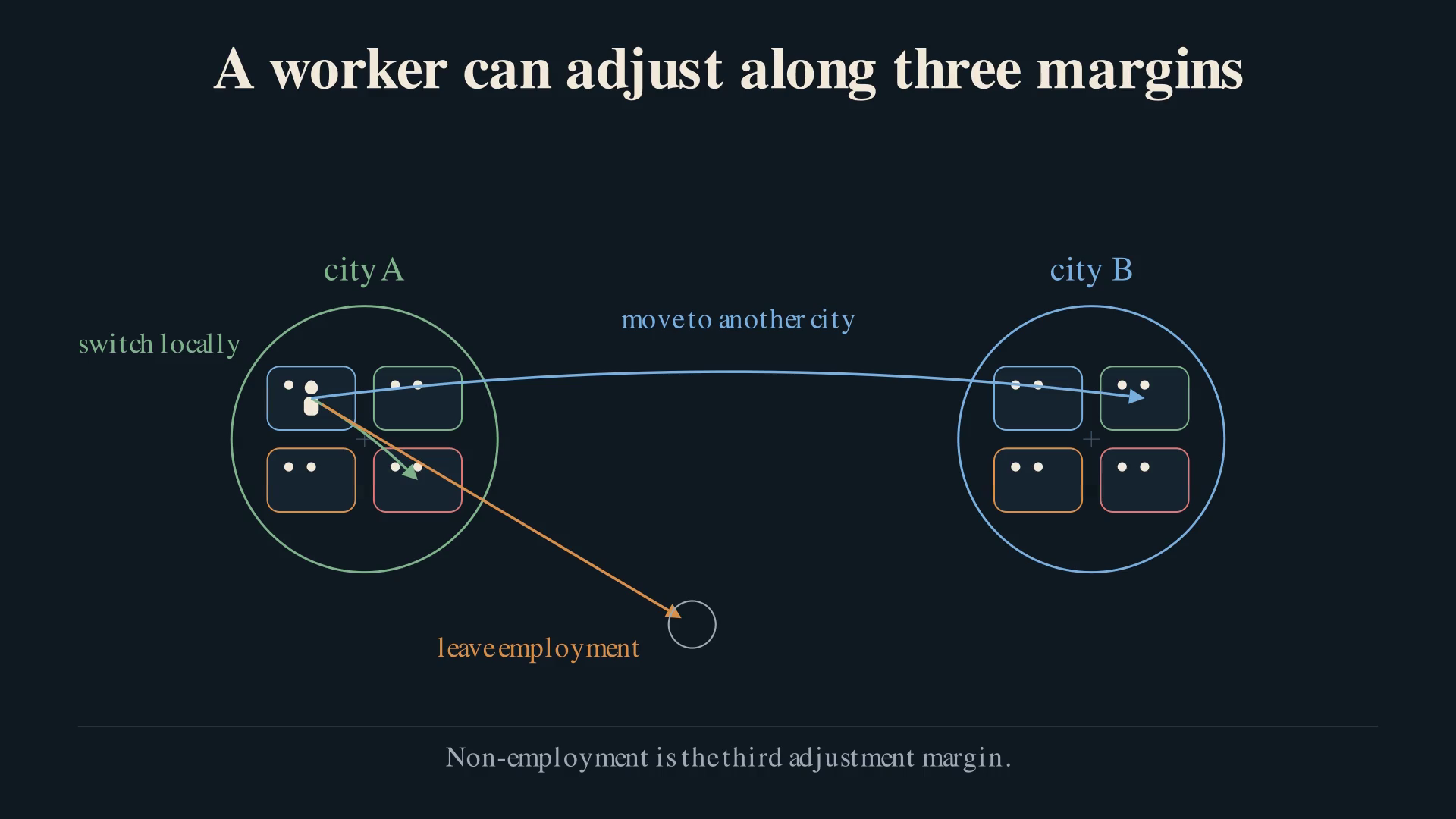
We develop a framework to assess how economic shocks affect local labor markets and worker welfare, with a focus on city-level economic diversity. Using detailed worker flow data across cities, sectors, and occupations, we construct theory-consistent welfare measures. Our approach combines a dynamic discrete choice model with a dual representation that captures both direct effects and the insurance value of local economic diversity. Applied to French labor markets, we find that diversification dampens the effect of negative shocks: both job-to-job moves and net inflows decline less in diverse cities than in concentrated ones. Overall, we document sizable welfare insurance gains from local economic diversity.
We use public trade and vessel-traffic data to measure US import exposure to maritime disruptions, weighting pressure along shipping routes by the imports that use them. The index identifies the goods and ports most exposed. Pressure peaked in January 2024 when Red Sea disruptions coincided with Panama Canal drought restrictions, affecting a broad range of nonenergy goods. The 2026 Hormuz disruption concentrated exposure on energy imports and refining centers.
Manim for Economics is a beginner-friendly toolkit for turning economics papers and models into animated explainers. It includes reusable project templates, visual themes, scene patterns, and examples for presenting mechanisms, comparative statics, empirical results, and welfare decompositions. The workflow keeps the animation code close to the underlying economic argument, making it easier to produce polished and reproducible videos. The repository also provides rendering and quality-check guidance for adapting the examples to new papers.
A rendered frame from the Economic Diversity example.
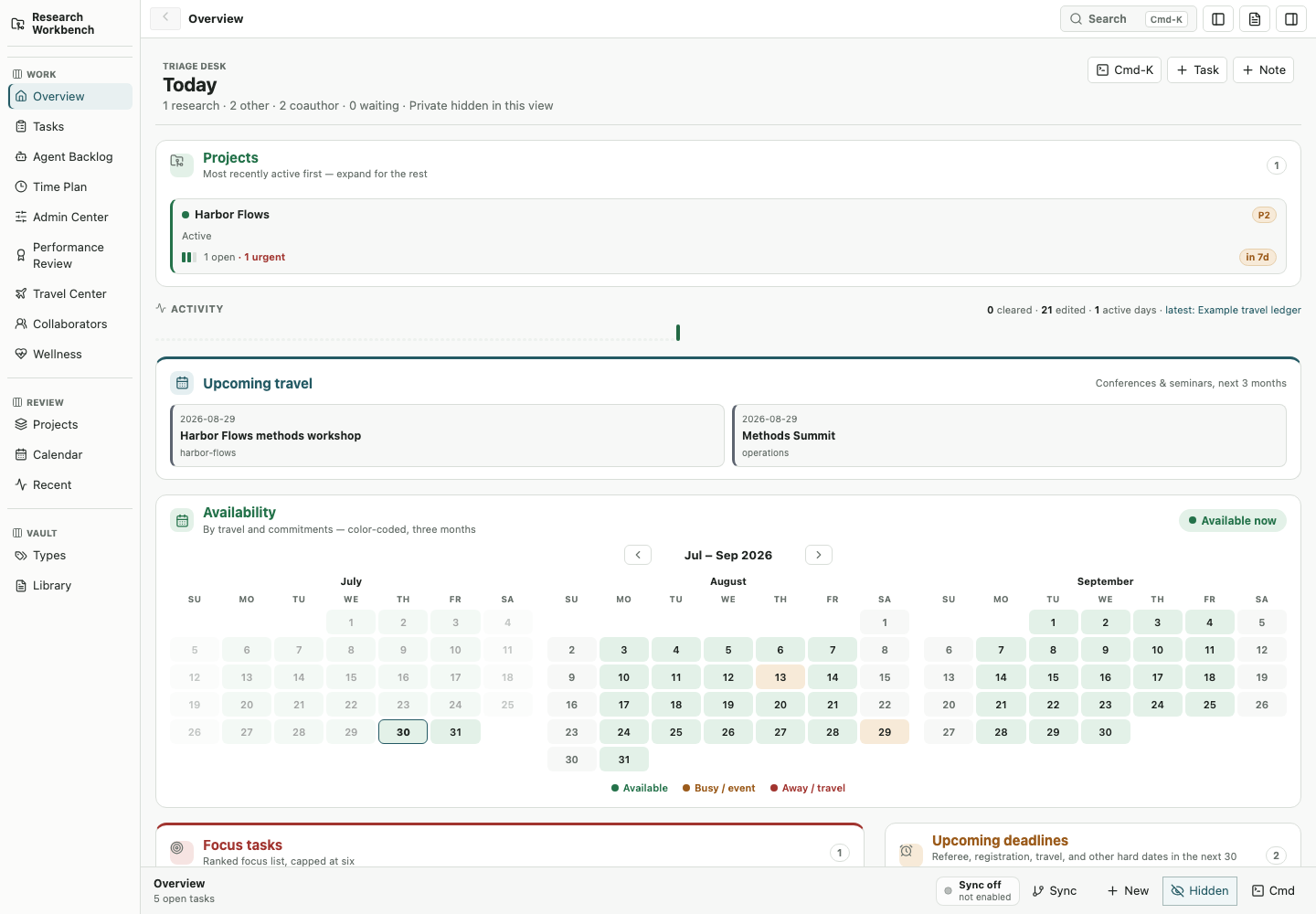
Task Manager is a Markdown-first system for managing research and administrative work. Through Codex, it can review email and other connected sources, extract actionable commitments, and keep project tasks and deadlines up to date. It brings project management, calendar and time planning, travel, spending, and recurring administrative work into one place. Because Markdown files remain canonical, the underlying information is easy to inspect, edit, and version-control.
Task Manager populated with synthetic example data.
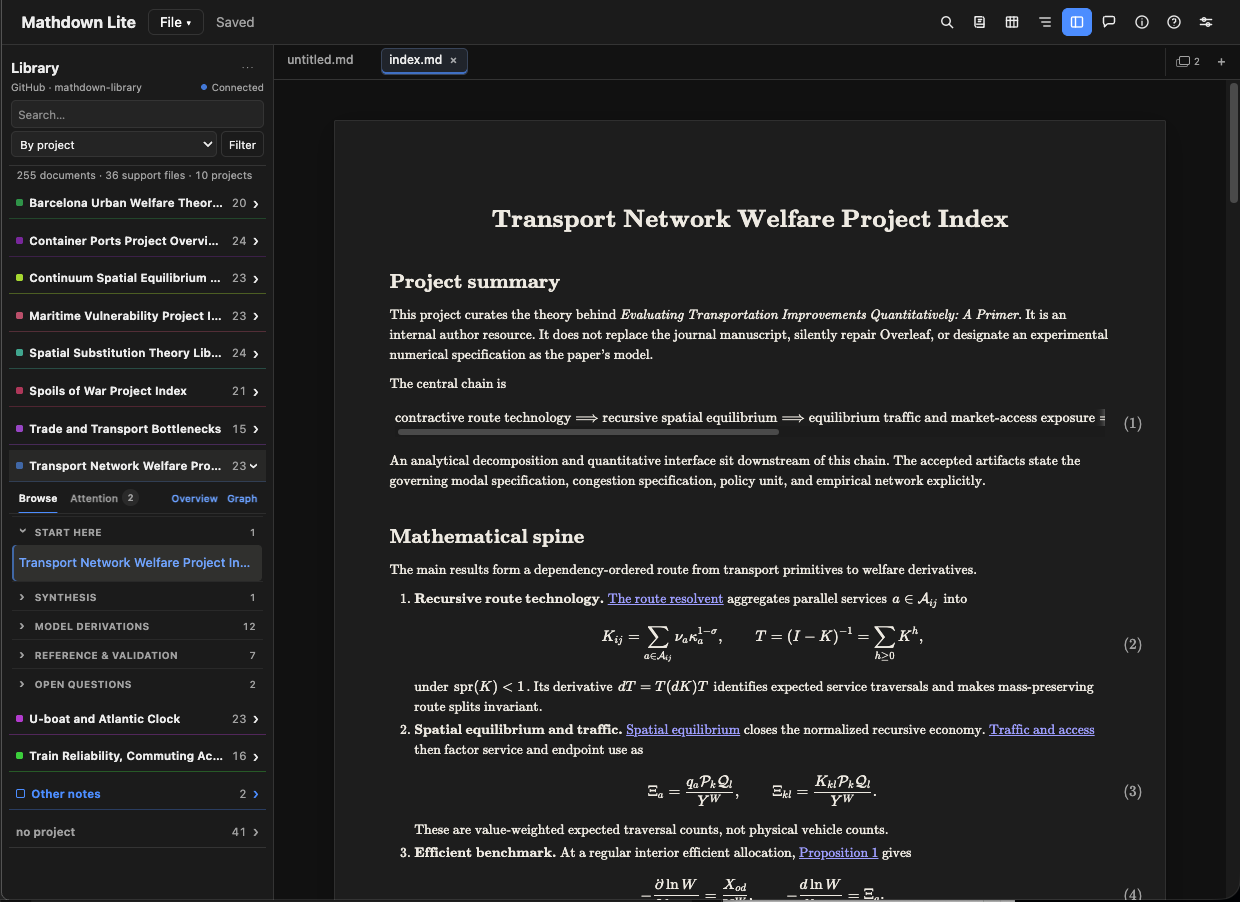
MdLyx is a research-library and theory-development environment built around Markdown files. It provides a LyX-like front end for live mathematics, citations, comments, cross-links, project organization, and dependency graphs while leaving readable Markdown in the background. The library view groups theory notes, derivations, references, validation, and open questions into navigable research projects. Its structure supports AI-augmented theory development by allowing Codex and other tools to work directly with the same underlying sources.
A Markdown-backed research library with rendered mathematics and project navigation.
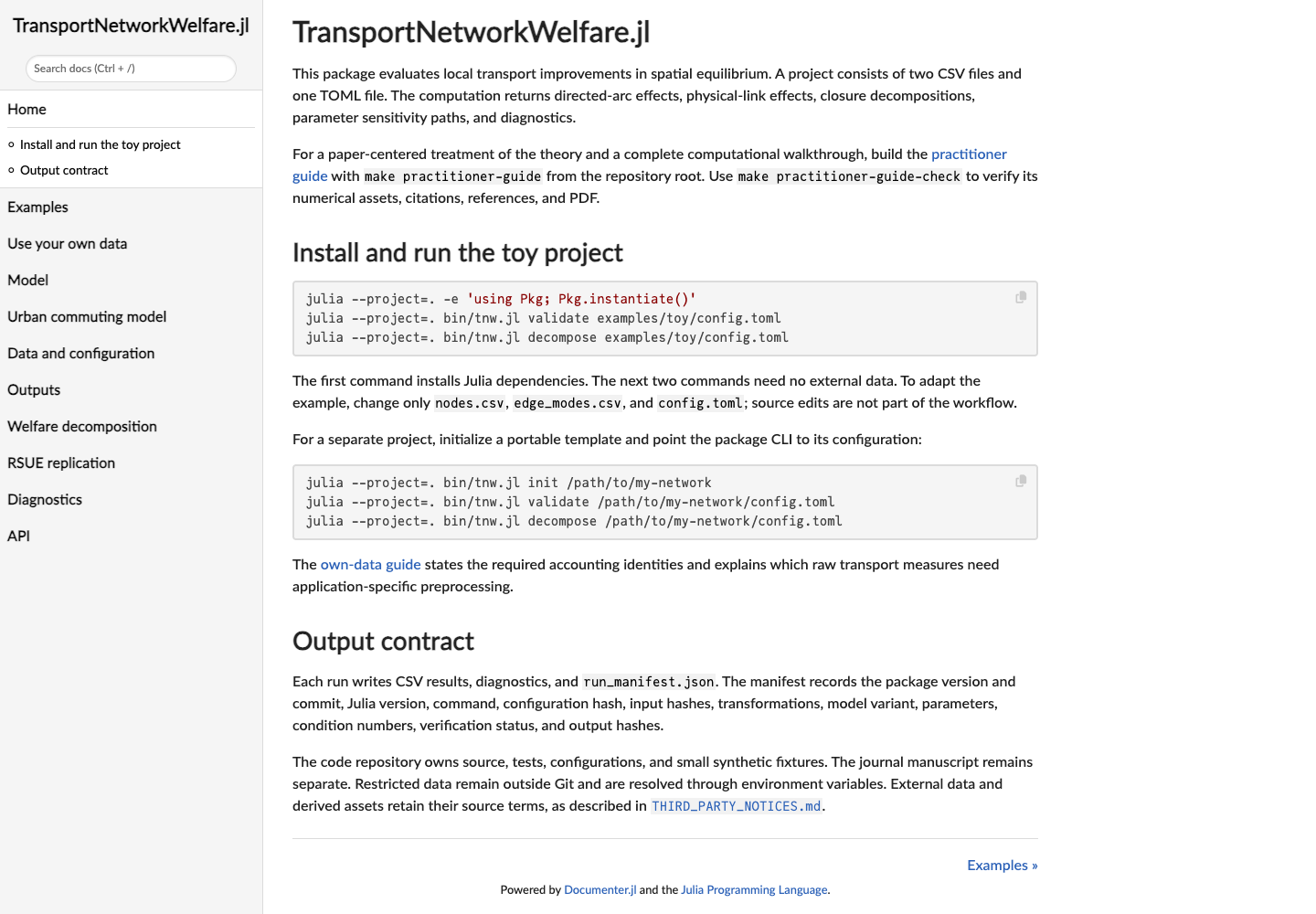
TransportNetworkWelfare.jl is a Julia package for computing the local welfare effects of marginal transport-cost changes in spatial equilibrium. It supports recursive routing, multimodal choice, edge and terminal congestion, directed and bidirectional policies, parameter sensitivity, and an exact closure decomposition. The package provides economic-geography and urban-commuting closures, together with command-line workflows and example projects for validating, analyzing, and decomposing transport changes. Its reproducible outputs include results, diagnostics, and manifests that record model settings and input and output hashes.
The package overview and documentation for the reproducible Julia workflow.